This post reproduces reporting I did for the Council on Foreign Relations as an Editorial Intern—read the original here.
Latin America has been hit hard by the COVID-19 pandemic, with reported cases and deaths soaring in recent months, especially in Brazil. Vaccination efforts have faced multiple roadblocks, including limited domestic production, controversy over vaccines from China and Russia, and difficult negotiations with U.S. and European manufacturers. Some experts worry vaccine diplomacy by Beijing and Moscow is expanding geopolitical influence, while others warn slow vaccination rates increase the risk of more dangerous variants.
What’s the State of the Pandemic in Latin America?
The region has had among the world’s largest outbreaks. By May 2021, the official death toll for Latin American countries combined was nearing one million people, and some experts believed the actual number of deaths was much higher. With 8 percent of the global population, Latin America accounted for 35 percent of all COVID-19 deaths globally.
Brazil in particular has been heavily affected, with more than fourteen million reported cases and over four hundred thousand deaths since the pandemic began. The country was also considered the origin of the P.1 variant, which appeared more contagious and spread rapidly through the region.
How Are Vaccination Efforts Going Across the Region?
Vaccination rates varied significantly based on population density, supply, and health-care infrastructure. Chile had distributed roughly seventeen million doses and fully vaccinated around 40 percent of its population. In countries such as Argentina, Colombia, and Mexico, the share with at least one dose was closer to 9-18 percent. In Brazil, despite a history of successful vaccination campaigns, about 17 percent had received at least one dose.
Overall, the region had administered more than 120 million doses, compared with more than 275 million in the United States and about 300 million in Europe. Vaccine portfolios also varied: different countries used different combinations of Oxford-AstraZeneca, Pfizer-BioNTech, Chinese-developed vaccines (CanSino, Sinopharm, Sinovac), and Russia’s Sputnik vaccine.
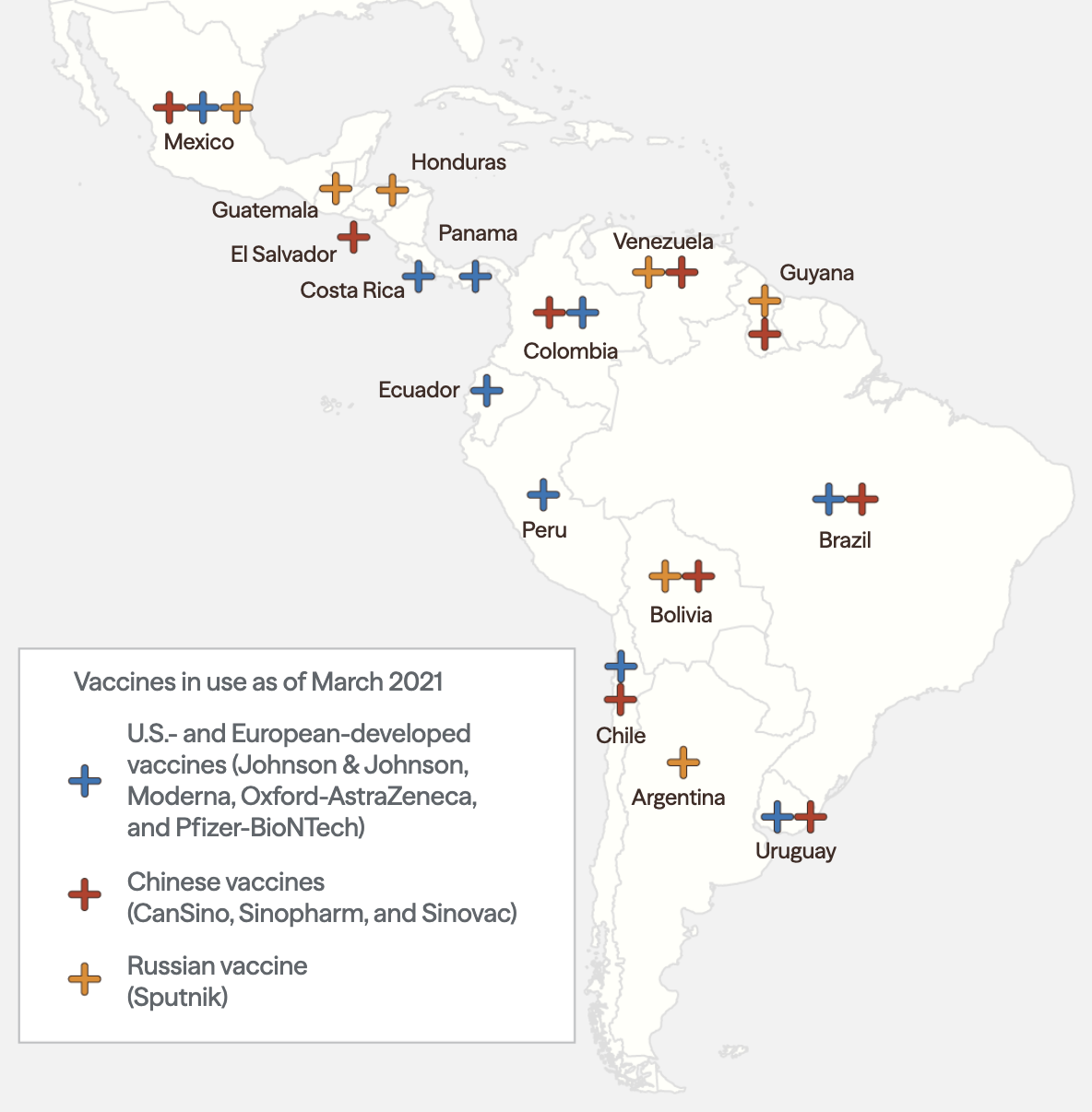
Many doses came through COVAX, the global initiative that aimed to deliver twenty-two million doses to the region by the end of that month. Seven manufacturers were involved in COVAX, including AstraZeneca, Johnson & Johnson, and Pfizer, and most Latin American countries had joined the initiative.
What Are the Challenges?
Reliance on external suppliers, especially China and Russia, generated significant concern. Few vaccines were produced in Latin America, with Cuba as a notable exception as it developed two domestic vaccine candidates despite major constraints.
Debate over efficacy and safety became central. Some Chinese-developed vaccines appeared to have lower efficacy rates, which some analysts linked to Chile’s case surge despite high vaccination levels. Broader political friction emerged as well: Peru investigated bribery claims, and Brazil’s politics split along pro- and anti-China lines. Reporting from the New York Times also suggested Bolsonaro’s stance on Chinese telecom infrastructure shifted in part to accelerate vaccine access.
Similar concerns appeared around Sputnik: delayed shipments pushed Mexico to arrange domestic bottling. In Brazil, officials discussed local production, but health authorities later blocked Sputnik use over safety and efficacy concerns.
Governments across the region pursued U.S. and European vaccines. Brazil and Mexico signed deals for hundreds of millions of doses, but deliveries were slow. Argentina and others accused Pfizer of hardball tactics during negotiations.
Distribution capacity remained another major obstacle: even where doses were available, communities with weaker public health infrastructure struggled with deployment. Public health experts warned that if rollout lagged, variants emerging in Brazil or elsewhere could undermine global recovery.
What Comes Next?
At a summit with European counterparts, Latin American leaders pressed for fairer vaccine distribution. Spain responded by announcing a donation of 7.5 million doses to the region by year-end.
U.S. policy remained a major variable. In March 2021, President Biden pledged 2.5 million doses to Mexico and later raised that to 7.5 million, while also committing at least $4 billion to COVAX. The administration also pledged sixty million additional doses for global distribution and backed waiving vaccine-related intellectual property protections, a move that some argued could eventually help regional manufacturing.
Even so, experts noted that scaling manufacturing takes time. Others argued that as U.S. supply exceeded demand, Latin America should receive priority access to surplus doses. Contracts were another constraint, since many limited foreign redistribution of doses by purchasing countries.